Scan the QR Code on Your Phone To Download the App



Scan the QR Code on Your Phone To Download the App
Scan the QR Code on Your Phone To Download the App


Buying a pre-owned Rolex is exciting, but ensuring originality is crucial to protect your investment. Check for features such as a smooth, sweeping second hand and the proper heft associated with quality materials.
Authenticating a Rolex also involves examining the watch’s serial and model numbers. You can cross-reference them with official Rolex records or consult experienced dealers and service centers that offer expert assessments and authenticity reports.
In Singapore, buyers turn to trusted local dealers to verify Rolex’s authenticity. Detailed checks by professional appraisers ensure peace of mind. Keep reading to learn how to check Rolex authenticity like a pro.
Rolex watches are renowned for their precision and craftsmanship, steeped in a history that defines luxury horology. They’re constructed from meticulously selected materials and feature movements that highlight cutting-edge watchmaking technology.
Rolex, founded in 1905 by Hans Wilsdorf and Alfred Davis, quickly established a reputation for precision. The brand became the first to earn the Swiss Certificate of Chronometric Precision for a wristwatch in 1910.
Rolex’s innovations, such as the waterproof Oyster case introduced in 1926 and the first self-winding movement with a Perpetual rotor in 1931, underscore its commitment to quality.
Its role in pioneering automatic winding mechanisms and developing watches for aviation, diving, and exploration professionals further cemented its standing as a pioneer in the industry.
Rolex carefully selects premium materials that reflect its commitment to quality, durability, and luxury. Here’s a look at some of the materials Rolex uses and models crafted from each:
1. Oystersteel (904L Stainless Steel)
Description: Unlike standard stainless steel, Rolex uses Oystersteel—a highly corrosion-resistant superalloy in the 904L family, often used in high-tech and chemical industries. Known for its superior hardness, this steel resists pitting and maintains a remarkable sheen even after exposure to harsh conditions. It’s more costly and challenging to machine, but Rolex invests in it for its durability and luxurious appearance.
Models: Submariner, Sea-Dweller, Oyster Perpetual, Air-King.
2. Rolesor (Steel and Gold Combination)
Description: Rolesor is Rolex’s iconic mix of Oystersteel and 18k gold, available in yellow, white, or Everose (rose gold) varieties. This combination combines the resilience of steel with the luxurious touch of gold, creating a balanced look for everyday elegance.
Models: Datejust, Sky-Dweller, Yacht-Master, Lady-Datejust.
3. 18k Gold (Yellow, White, and Everose Gold)
Description: Rolex exclusively uses its in-house foundry to create 18k gold alloys, ensuring consistent color, luster, and quality. Everose, a proprietary rose gold alloy, is mixed with platinum to prevent fading over time, while white and yellow golds offer timeless brilliance and refinement.
Models: Day-Date (President), Cosmograph Daytona, Lady-Datejust.
4. Platinum
Description: Rolex uses 950 platinum—a combination of 95% platinum with other metals—to enhance its strength while preserving its luxurious weight and polish. Known for its distinct silver hue, platinum Rolex watches are rare and exude exclusivity and prestige.
Models: Day-Date 40, Cosmograph Daytona, 1908.
5. Cerachrom Ceramic
Description: Cerachrom is Rolex’s proprietary ceramic material, engineered for scratch resistance and color durability. It’s highly resistant to UV rays, keeping colors vibrant, and provides additional robustness to watches with rotatable bezels. The numbers on the bezels are embedded with gold or platinum for extra elegance.
Models: GMT-Master II, Submariner, Daytona.
6. Sapphire Crystal
Description: Used to protect the dial, Rolex’s synthetic sapphire crystal is highly scratch-resistant and anti-reflective. This crystal is nearly as hard as a diamond and preserves its clarity even in rough conditions, ensuring readability and durability across decades.
Models: Practically all modern Rolex models, including the Datejust, Day-Date, and Explorer.
7. Rolesium
Description: A term coined by Rolex to describe the combination of stainless steel and platinum in their watches. Introduced in 1999, this blend features a robust Oystersteel case and bracelet paired with a 950 platinum bezel, imparting a distinctive silvery whiteness and vibrant luminosity.
Model: Yacht-Master

Rolex offers a range of meticulously crafted bracelet types, each designed for style, comfort, and durability. Here’s an overview of the key Rolex bracelet types:
1. Oyster Bracelet
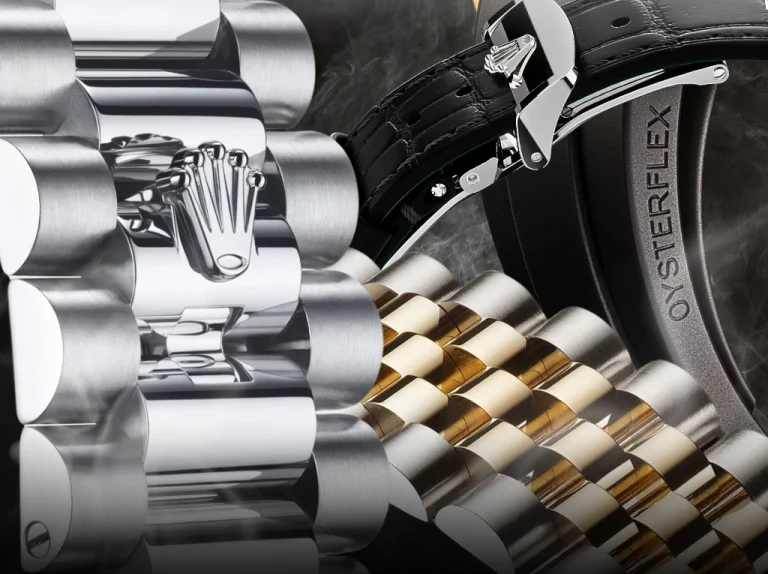
Description: The most iconic and versatile Rolex bracelet, the Oyster has a three-link structure that provides durability and a sporty look. Known for its robustness, the Oyster bracelet is suitable for both professional and casual wear, and it often includes the Oysterlock clasp or the Easylink comfort extension system for adjustability.
Models: Submariner, GMT-Master II, Daytona, Oyster Perpetual.
2. Jubilee Bracelet
Description: Introduced in 1945 for the Datejust, the Jubilee bracelet features a five-link design with a more elegant, dressy appearance. It offers a refined and comfortable fit on the wrist, with a blend of polished and brushed links that highlight Rolex’s craftsmanship. The Jubilee bracelet is often equipped with the Crownclasp or the Oysterclasp.
Models: Datejust, GMT-Master II.
3. President Bracelet
Description: Known for its luxury and sophistication, the President bracelet has a three-link semi-circular design, exclusively available in precious metals (gold or platinum). This bracelet is a hallmark of the Day-Date and some Lady-Datejust models. It’s fitted with a concealed Crownclasp, enhancing its seamless, elegant look.
Models: Day-Date (President), Lady-Datejust.
4. Pearlmaster Bracelet
Description: The Pearlmaster bracelet has a distinctive five-link design exclusively made in 18k gold (yellow, white, or Everose). Its rounded, polished links give it a luxurious, jewelry-like quality, making it perfect for Rolex’s gem-set models. This bracelet is designed for maximum refinement and is typically used in more ornate and exclusive models.
Models: Pearlmaster.
5. Oysterflex Bracelet
Description: Unlike a traditional rubber strap, the Oysterflex combines a flexible titanium-nickel metal blade covered with a high-performance elastomer for a durable and comfortable fit. It’s equipped with a Glidelock or Oysterlock clasp and includes a cushioning system for additional comfort. The Oysterflex is ideal for sporty models, combining the look of a rubber strap with the strength of metal.
Models: Yacht-Master, Daytona, Sky-Dweller.
6. Leather Strap
Description: Rolex’s leather straps are meticulously crafted from high-quality alligator leather, designed for comfort and durability. They often feature a calfskin lining and tone-on-tone stitching, enhancing their refined appearance. They’re equipped with the Dualclasp, an 18 kt yellow gold folding clasp that ensures a secure and comfortable fit.
Models: 1908, Cellini, Sky-Dweller, Daytona, Day-Date 36
Identifying genuine Rolex watches involves checking several distinct features. They include:
A genuine Rolex watch will have a finely etched crown logo, typically located at the 6 o’clock position on the crystal. This logo should be visible only under certain angles or lighting conditions. The etching is crisp and detailed, unlike the blurry or inconsistent markings on fake watches.
In addition, inspect the crown logo on the dial, ensuring it’s perfectly aligned and meticulously crafted. Fakes often have logo imperfections or slightly off-center placements. The level of detail in these etchings is a strong indicator of authenticity.
Authentic pre-owned Rolex watches typically have smooth case backs, often marked with nothing but metal. Some diving models, like the Sea-Dweller, are exceptions with additional engravings. If a Rolex features transparent or detailed engravings on the back, it might be a fake Rolex.
Examining the case back can reveal the solid craftsmanship typical of genuine Rolex timepieces. Any logos or inscriptions should be checked against known authentic references. Often, fakes will attempt detailed engravings that don’t match legitimate models.
A genuine Rolex movement provides a smooth, sweeping motion of the second hand. This motion is powered by the high-frequency ticking of the Perpetual movement, reducing visible ticks compared to standard quartz watches.
Counterfeit models often use quartz movements, producing a ticking second hand. The tension and fluidity of the hand should be observed closely. This craftsmanship is a hallmark of a legitimate watch, showcasing the precise engineering Rolex is known for.

The Cyclops lens on authentic Rolexes magnifies the date 2.5 times, allowing for clear readability. In counterfeit models, the lens often lacks sufficient magnification, making the date appear smaller or less sharp.
Checking the clarity and enlargement of the date through the Cyclops lens can quickly pinpoint authenticity. Additionally, inspect the alignment over the date window, as genuine watches will exhibit precise placement.
Authentic Rolex watches are constructed with high-quality materials, contributing to a noticeable heft. The use of precious metals and robust steel results in a weighty feel not found in fakes. Holding the watch, one should expect a certain density and solidness.
Examining the case, bracelet, and links for superior workmanship and sturdiness can further confirm genuineness. Quality is often sacrificed in counterfeits, leading to lightweight and flimsy pieces that do not match Rolex’s robust standards.
Rolex engraves serial and model numbers with laser precision. These numbers should be checked for clarity and accuracy. They are located between the lugs or engraved inside the watch case surface. Counterfeits may display shallow or poorly executed numbers.
You can strengthen validity by cross-referencing these numbers with Rolex records. A genuine number properly aligns with the watch’s age and model. Fakes often have inconsistent fonts or patterns that fail to replicate the authentic look.

The bracelet and clasp of a Rolex offer intuitive evidence of authenticity. The bracelet should have a smooth, sturdy feel with tight-fitting links. The clasp itself should be intricately detailed and operate seamlessly.
Inspection should focus on link alignment and clasp engravings. These components should exhibit impeccable craftsmanship with crisp and clear engravings. Counterfeit clasps might show uneven edges or off-center logos, betraying their inauthenticity.
Rolex watches are renowned for their superior operation due to their intricate movement. Genuine modern models tick at a rate of 8 beats per second, stated as 28,800vph. If subtle ticking isn’t present, it indicates a fake using a quartz mechanism.
Please note there’s a difference between a tick and tick-tock sound. Authentic Rolexes don’t produce a tick-tock sound. Also, the tick in some models is louder than others, so listening carefully to the watch in a quiet environment can help you hear it.
Here’s a detailed explanation of each instance where seeking professional authentication for a Rolex watch is essential:
An authentic Rolex watch with unclear ownership history—meaning it lacks original purchase documents, receipts, or warranty papers—raises authenticity concerns. Knowing a Rolex’s origin can help confirm its legitimacy, but without such records, verifying if it has passed through trusted channels becomes difficult.
In these cases, a professional authenticator can examine the watch thoroughly, using knowledge of specific markers and identifiers that might not be apparent to the untrained eye. This process ensures that the watch matches Rolex’s standards and isn’t a counterfeit.
Buying a pre-owned Rolex presents risks, especially from private sellers or online marketplaces. Not all sellers have the expertise or ethical standards to guarantee authenticity, which means a buyer might end up with a counterfeit. Additionally, sellers may unknowingly offer watches with aftermarket modifications that reduce value.
Professional authentication during these purchases can verify that the watch is genuine and in its original, unmodified state, protecting your investment.
Due to their high market value, counterfeiters often target Vintage Rolex models and rare editions. To deceive buyers, many fakes attempt to replicate popular vintage features, such as faded dials or patina. Some counterfeiters even create models that look genuinely aged but are, in fact, replicas.
An expert can identify specific vintage details, such as the correct reference numbers, font styles, lume color, and dial printing, which vary by era and model. Authentication in these cases can confirm that all components are original Rolex and that the watch holds the value expected of a vintage piece.
Rolex watches are made to be durable, but significant wear, part replacements, or customization can alter their authenticity and value. For example, replacing the crystal or changing the bracelet with non-Rolex parts affects the integrity of the original design.
In cases where visible modifications or repairs are present, a professional can determine if any parts are non-original and whether these modifications impact authenticity and value. Additionally, professionals have access to Rolex’s service records, which can sometimes reveal any official or unauthorized changes made to the watch.
Each Rolex watch has unique serial and model numbers engraved on specific parts, typically on the case between the lugs. These numbers help trace a Rolex’s production and verify its authenticity. If a Rolex is missing these numbers, or if they appear altered or faint, it could indicate tampering, which may mean the watch is stolen or counterfeit.
Rolex professionals use advanced techniques to detect and validate serial and model numbers even when they’re faded. This can confirm whether the watch is legitimate or has been altered to deceive buyers.
Authentication offers peace of mind for both buyer and seller for any high-value Rolex, especially limited editions or investment pieces. Professional authentication ensures you purchase a genuine Rolex without hidden issues that could impact value.
Sellers can also benefit, as a verified certificate of authenticity can boost the sale price and attract serious buyers. Authentication in these cases acts as a quality assurance step, safeguarding both the watch’s reputation and the transaction itself.
Rolex has high standards for its branding, including details like the Rolex crown, dial fonts, date magnification, and overall craftsmanship. Inconsistent branding—such as an unusually large logo, different font style, or subtle design errors—can signify a counterfeit. Fake Rolexes often mimic branding elements but fall short in quality.
Authenticators are trained to spot these discrepancies, as they are familiar with the brand’s evolution in logo design, dial printing techniques, and subtle differences across models.
If a Rolex watch feels suspiciously lightweight, has slight visual differences, or just doesn’t seem “right,” these could be signs of a counterfeit or cloned watch. Counterfeiters continue to improve their techniques, making it increasingly difficult to distinguish genuine watches from high-quality fakes.
Professionals use specialized tools to confirm the authenticity of materials, movement, weight, and other factors that are harder to replicate accurately. Authentication provides a detailed assessment, detecting even the most well-made counterfeits and clones.
Verifying a pre-owned Rolex’s authenticity requires examining its serial number, movement, weight, and craftsmanship alongside professional verification. By following these steps, you can confidently ensure your investment is genuine, avoid counterfeits, and secure a timeless piece that reflects Rolex’s legendary quality and precision. Authenticity matters—always double-check.
Key Takeaways
Looking to buy or sell your luxury watches? Watchbook is your one-stop destination for trading Rolex, Patek Philippe, Tissot, Sinn, Zenith, and other luxury timepieces. Find your next watch today or list your item for free!