Scan the QR Code on Your Phone To Download the App



Scan the QR Code on Your Phone To Download the App
Scan the QR Code on Your Phone To Download the App


A tachymeter is a sophisticated tool that combines both style and functionality. It features a scale typically inscribed on the rim of an analog chronograph watch and does more than give the timepiece an attractively rugged appearance.
Depending on the watch model, it can be fixed to the case or part of a rotating bezel. It measures the time an object takes to travel a certain distance, converting these seconds into speed units per hour.
The detailed tachymeter watch article below provides all the information you need to know about this handy instrument so you can use it with confidence.

A tachymeter is a scale typically found on chronograph watches. It is usually inscribed around the bezel or the outer edge of the watch’s main dial. Its primary function is to convert elapsed time into speed.
The tachymeter’s history traces back to 1816 when Louis Moinet, a renowned French watchmaker, developed the first chronograph, which he referred to as a “compteur de tierces.” This groundbreaking invention was designed primarily for astronomical purposes, allowing precise measurements of time intervals.
The device featured a central seconds hand capable of making a complete revolution in one second, facilitating the calculation of speeds and distances. Although not initially recognized as a tachymeter, it laid the foundation for future developments in chronograph technology.
By the mid-20th century, tachymeter scales became a standard feature on chronograph watches, prominently used in automotive and aviation industries for measuring approximate speed over a known distance. Over the years, tachymeters have evolved with technological advancements in watchmaking, becoming more accurate and easier to use.
Today, they remain a popular feature for watch enthusiasts and professionals, commonly found on the bezels or dials of various sports and luxury watches, adding functional and aesthetic value and symbolizing precision and the rich heritage of horological innovation.
The tachymeter has various practical applications in multiple fields:
Using a tachymeter scale on a watch involves a few simple steps to measure speed over a known distance. Here’s a step-by-step guide:
Example Calculation
Imagine driving a car. As the vehicle passes a mile marker, start the chronograph. When the car reaches the next mile marker, stop the chronograph. If the elapsed time is 30 seconds, use the tachymeter scale to find the average speed. A reading of 120 on the tachymeter scale indicates 120 miles per hour.
Explanation:
The formula for a tachymeter is based on the relationship between time, speed, and distance. The tachymeter scale on a watch is typically used for measuring speed over a fixed distance (usually one mile or one kilometer). Here’s the fundamental formula used in tachymeters:
Speed (units per hour)=3600/ Elapsed Time (seconds)
If you travel one mile (or one kilometer) and it takes you 30 seconds to do so, you can use the formula as follows:
Speed=3600/30=120 units per hour
This means you are traveling at a speed of 120 miles per hour (or kilometers per hour).
Here are specific models with tachymeter scales from top luxury watch brands:

About
This Daytona is a luxurious men’s chronograph watch featuring a 40mm Everose gold case, a black dial with golden hands, and subdials at 3,6, and 9 o’clock. It includes an engraved tachymeter scale on its bezel, an Oyster bracelet, and it’s renowned for its precision, durability, and timeless elegance.

About
This Speedmaster men’s model features a 42mm platinum case, a black ceramic bezel with a white enamel tachymeter scale, and a black dial with lunar meteorite subdials. Powered by the Caliber 321 movement, it’s known for its precision, encapsulated in a sapphire crystal case back and a black leather strap.
About
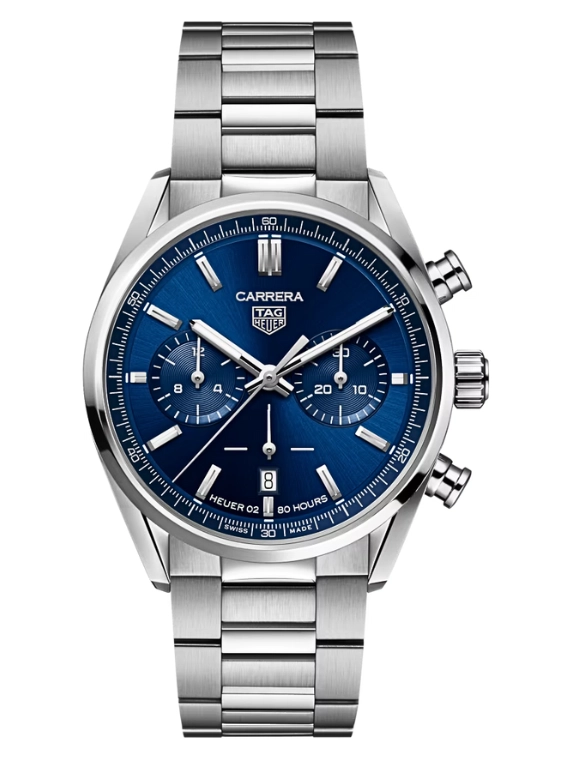
This stylish men’s Carrera chronograph features a 42mm stainless steel case, a sleek silver sunray-brushed dial, and a polished steel bezel with a tachymeter scale. Its automatic movement powers the chronograph function, with subdials for precise timing. It’s completed with a stainless steel triple-row bracelet, offering sophistication and functionality in equal measure.

The tachymeter dial on a watch is typically a logarithmic scale. A logarithmic scale is a nonlinear scale used for a large range of quantities. On a tachymeter, this scale is designed to compress a wide range of values into a smaller space, allowing it to display speeds ranging from 60 to 500 units per hour clearly and efficiently.
The markings on the scale are not equally spaced; instead, they follow a logarithmic progression. The units per hour correspond to elapsed times from 60 seconds to 7.2 seconds over a fixed distance (usually one mile or one kilometer). Here’s how it works:
Here are some of the perks and drawbacks of a tachymeter bezel:
Its necessity depends on your specific needs and interests. It can be useful if you’re involved in activities requiring speed measurement over a fixed distance, such as motorsports or aviation. However, if you’re an everyday user who doesn’t need this functionality, it’s more of an aesthetic feature rather than a necessity.
There are alternative features that are equally helpful:

Here’s a table highlighting the differences and unique benefits of both tools:
|
Feature |
Tachymeter |
Telemeter |
|---|---|---|
|
Purpose |
Measures speed over a fixed distance |
Measures distance to an observable and audible event |
|
Functionality |
Converts travel time over a set distance into speed |
Measures time between seeing and hearing an event, calculates distance |
|
User Cases |
Motorsports, aviation, everyday speed estimation |
Weather observation, military operations, outdoor activities |
|
Unique Benefits |
Quick speed calculation, technical appeal, chronograph integration |
Distance estimation, safety tool, useful for outdoor and weather scenarios |
|
Limitations |
Fixed distance, best for medium to high speeds |
Situational, dependent on observable and audible events |

The following table shows the application of both instruments in different fields and more:
|
Feature |
Tachymeter |
Pulsometer |
|---|---|---|
|
Application |
Measures speed over a fixed distance |
Measures heart rate by counting beats over a set period |
|
Fields of use |
Motorsports, aviation, everyday speed estimation |
Healthcare, sports and fitness, emergency services |
|
Unique Benefits |
Quick speed calculation, technical appeal, chronograph integration |
Health monitoring, fitness optimization, portable and convenient |
|
Limitations |
Fixed distance, best for medium to high speeds |
Specific to heart rate, requires precise timing |
A tachymeter adds functionality and classic appeal to a racing watch. It allows users to measure speed or distance based on elapsed time, making it a valuable and crucial tool for enthusiasts and professionals who appreciate precise measurement on their timepieces.
Key Takeaways
Looking to buy or sell your luxury watches? Watchbook is your one-stop destination for trading Rolex, Patek Philippe, Tissot, Sinn, Zenith, and other luxury timepieces. Find your next watch today or list your item for free!