

Scan the QR Code on Your Phone To Download the App



Scan the QR Code on Your Phone To Download the App
Scan the QR Code on Your Phone To Download the App

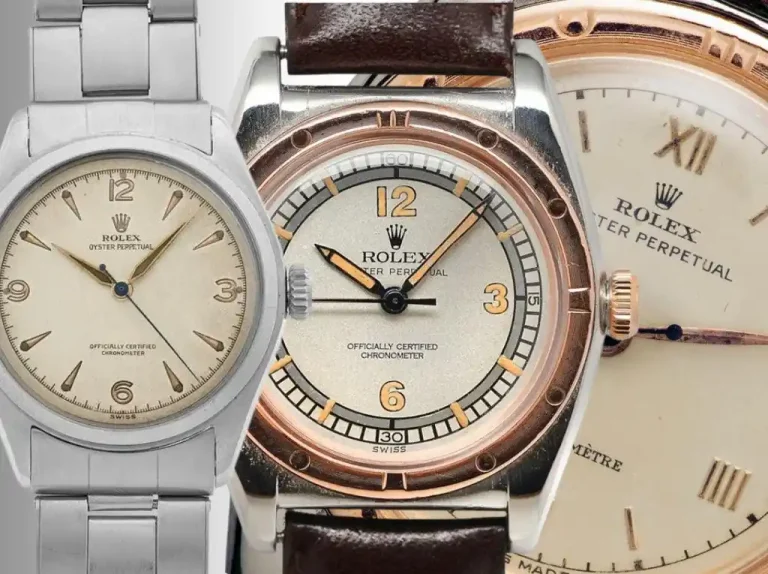
Few vintage Rolex watches have a caseback as unusual as the Rolex Bubbleback. Its rounded, protruding shape gives the watch its nickname. The design appeared on early Rolex Oyster Perpetual models, whose thick self-winding movements required additional space.
Introduced in the 1930s, the Bubbleback followed Rolex’s development of the Perpetual rotor in 1931. This innovation allowed the watch to wind itself through wrist movement, marking an important milestone in automatic watchmaking and shaping the future of Rolex.
But what makes the Bubbleback more than an unusual vintage design? Whether you’re a Rolex enthusiast or collector, this article explores its nickname, automatic movement, historical references, distinctive design variations and enduring appeal.
The Rolex Bubbleback refers to an early generation of Rolex Oyster Perpetual automatic wristwatches introduced during the 1930s. Its most recognizable feature is the rounded, protruding caseback, which gives the watch a distinctive profile when viewed from the side. Although widely used by collectors, Bubbleback was never an official Rolex collection or model name. Instead, it is a nickname for a family of vintage Rolex references that share this unusual case design.
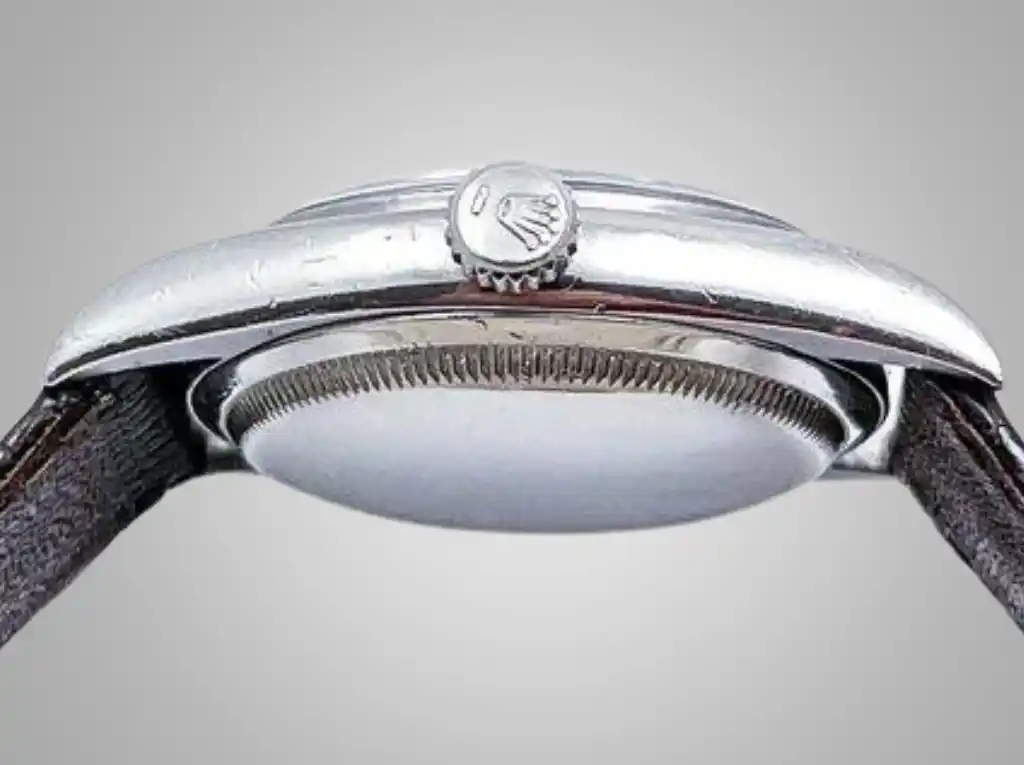
The name comes from the caseback’s resemblance to a small bubble. Its pronounced shape was not simply a design choice but a practical solution to accommodate the relatively thick automatic winding mechanism inside. This distinctive construction became one of the defining characteristics of early Rolex Bubblebacks.
The Rolex Bubbleback brought together two important developments in the brand’s early history: the Oyster case and the Perpetual rotor.
The Oyster case (1926): Rolex introduced a screw-down crown, bezel and caseback to protect the movement from water and dust, establishing water resistance as a defining feature of its watches.
The Perpetual rotor (1931): Patented by Rolex, this centrally mounted oscillating weight moved with the wrist to wind the mainspring automatically. Developed alongside movement manufacturer Aegler, the mechanism reduced the need for daily manual winding.
Together, these innovations laid the foundation for the Oyster Perpetual. The first Bubbleback generation followed in 1933, with reference 1858 commonly associated with its introduction.
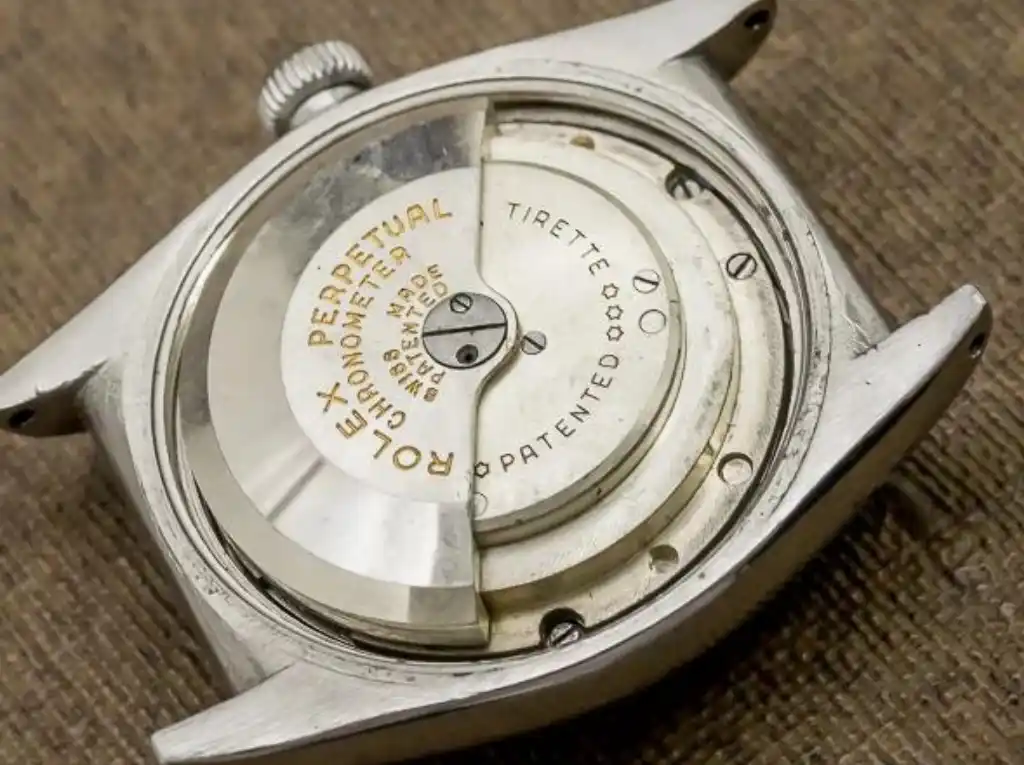
The Rolex Bubbleback uses an early self-winding movement powered by wrist movement. Unlike manually wound watches, which require regular winding through the crown, it relies on an oscillating rotor to replenish its power reserve.
The process is relatively simple:
The rotor could swing freely through 360 degrees, although early Bubbleback calibres are generally described as winding the mainspring in one direction only. This self-winding mechanism made automatic timekeeping practical and reduced the need for daily manual winding. Bidirectional winding arrived with later movements, including the Calibre 1030 introduced in 1950.
The early automatic movements used in Rolex Bubblebacks were relatively thick. The rotor and its associated winding components required additional vertical space, making a conventional flat caseback impractical. Rolex addressed this by designing a rounded caseback that accommodated the movement without compromising the watch’s overall construction.
This protruding shape became the Bubbleback’s defining feature. What initially served an engineering purpose eventually gave the watch its enduring nickname and distinctive vintage appeal.
| Feature | Rolex Bubbleback | Modern Rolex automatic watch |
|---|---|---|
| Movement construction | Early, relatively thick automatic movement | More compact and refined architecture |
| Caseback | Prominent domed profile | Generally flatter profile |
| Winding system | Early Perpetual rotor, generally one-directional | Later bidirectional Perpetual rotor and refined winding components |
| Overall proportions | Smaller vintage case with a pronounced back | Generally more contemporary case proportions |
The difference reflects decades of progress in movement engineering. Modern Rolex movements achieve more compact construction, allowing for slimmer case profiles without the pronounced bulge that made the Bubbleback instantly recognizable.
The first Rolex Bubbleback appeared in 1933, with reference 1858 marking the beginning of this distinctive family of Oyster Perpetual watches. It featured a three-piece case construction and a prominent domed caseback to accommodate its early automatic movement. Measuring approximately 32mm, it established the compact proportions and distinctive profile that would become synonymous with Bubblebacks.
By 1936, Rolex introduced revised two-piece case designs with references 3131 and 3132. Unlike earlier examples, these watches used a simplified construction that integrated the bezel into the main case, with the caseback screwing directly into the case middle. This marked an important development in Bubbleback case architecture, although construction details continued to vary across subsequent references.
During the 1940s, Rolex expanded its Bubbleback range with different reference numbers, case materials and dial configurations. Examples were produced in stainless steel, yellow gold, pink gold and two-tone combinations. In 1941, Rolex also introduced a smaller ladies’ version measuring approximately 24mm and powered by Calibre 420. These variations catered to different preferences, offering a wider selection of sizes and designs.
From the late 1940s into the 1950s, larger transitional designs, often described by collectors as Big Bubblebacks and Semi-Bubblebacks, appeared, generally measuring around 34mm. These models reflected Rolex’s continued development of larger automatic Oyster watches following the introduction of the Datejust in 1945, as the brand moved toward flatter case designs. Introduced in 1950, the Calibre 1030 featured a smaller, bidirectional rotor and a slimmer automatic architecture. It enabled Rolex to move beyond the Bubbleback’s domed caseback toward flatter Oyster Perpetual cases.
Across these two decades, Rolex fitted Bubblebacks with several early automatic movement families, from the Calibre 520 used in the first-series ref. 1858 to the Calibre 420 found in ladies’ versions. Knowing which calibre belongs in which reference is one of the most useful checks when assessing a Bubbleback’s originality.
The Rolex Bubbleback is not a single watch but a family of vintage Oyster Perpetual references produced with different case constructions, movements and dial configurations.
Although they share the characteristic domed caseback, individual references have distinct features that make certain examples particularly interesting. Understanding these differences can also help when assessing a Bubbleback’s originality.
| Reference | Key characteristics | Historical significance |
|---|---|---|
| 1858 | Early Oyster Perpetual with a domed caseback and three-piece case | Recognized as the first Bubbleback, introduced in 1933 |
| 2940 | Approximately 31mm to 32mm case with varied dial configurations | A widely encountered Bubbleback reference from the 1940s |
| 3131 | Two-piece case construction with subsidiary seconds | Part of the revised case design introduced around 1936 |
| 3132 | Related two-piece case with central seconds | Companion reference to the 3131, with a different seconds display |
| 3372 | Approximately 32mm case with different bezel and dial configurations | Notable for its varied configurations |
| 3599 | Hooded lugs, broad flat bezel and domed caseback | An unusual variation with covered lug openings |
| 3065 | Integral hooded-lug Oyster Perpetual design | Demonstrates the diversity of Bubbleback case styles |
Early references illustrate Rolex’s refinement of automatic watches. The ref. 1858 introduced the Bubbleback family, while the ref. 2940 is notable for its varied dial configurations, including 24-hour and California-style examples. Unusual dials require careful inspection, as some may not retain their original factory finish.
A different approach to case construction appears in references 3131 and 3132. Both feature the revised two-piece architecture, but their displays differ: the 3131 has subsidiary seconds at 6 o’clock, whereas the 3132 uses central seconds. The ref. 3372, meanwhile, adds further variety through its different bezel and dial configurations.
The references 3599 and 3065 offer an unconventional take on the Bubbleback. Both have hooded lugs, with the upper case extending over the spring-bar openings for a more integrated look. The ref. 3599 pairs this design with a broad, flat bezel, and hooded references like these are often regarded as among the most sought-after Bubbleback variants.
No. Most Rolex Bubblebacks measure approximately 30mm to 32mm in diameter, although some references are slightly larger. Rolex also produced smaller ladies’ versions, while later transitional designs known as Big Bubblebacks reached approximately 34mm to 36mm.
These larger watches helped bridge the gap between the original compact Bubblebacks and later Oyster Perpetual models. However, Big Bubbleback is a collector’s term rather than an official Rolex model designation, and its application can vary between dealers and collectors.
Beyond its distinctive caseback, the Rolex Bubbleback came in a surprising range of designs. Differences in case materials, bezels and lug shapes gave individual references their own character, making the collection particularly interesting to vintage watch collectors.
The domed caseback remains the easiest feature to recognize. Its rounded profile accommodated the relatively thick automatic movement, although its height and curvature varied between references. Viewed from the side, this protrusion gives the Bubbleback its characteristic silhouette and distinguishes it from later, slimmer Oyster Perpetual watches.
Case materials also contributed to the family’s variety. Stainless steel examples offer a more understated appearance, while yellow gold and pink gold models bring a warmer, more traditional look. Two-tone configurations combine stainless steel with gold elements, often around the bezel or other case components.
The availability of these materials depended on the reference and production period, offering different options within the Bubbleback family.
Bezel and lug designs provide further points of distinction. Some examples feature smooth bezels, while others have fluted, engraved or patterned finishes. Lug construction also varies, from conventional straight lugs to hooded designs such as those on references 3599 and 3065.
While the domed caseback is the defining feature of a Bubbleback, these design details help distinguish one reference from another.
Part of the Rolex Bubbleback’s appeal lies in the variety of dial configurations found across different references. While not exclusive to Bubblebacks, certain designs make individual examples particularly interesting. Their originality and condition can also influence a watch’s desirability.
The reference 2940 is particularly interesting for its unusual dial variations, including 24-hour and two-tone configurations. Sector dials, with contrasting sections and concentric markings, also appear on other Bubbleback references.
Some Bubbleback examples also feature half-Roman, half-Arabic numeral dials. Rolex produced original versions of this design in the 1940s, sometimes referred to as “Error-Proof” dials. The term California dial came later through the refinishing trade, so collectors should carefully assess whether an example retains its original factory configuration.
Other examples feature gilt printing and tropical dials. The latter develop brown or honey-colored tones as the original dial surface ages. These variations can add character, but an unusual appearance does not automatically indicate rarity or originality.
The condition, authenticity and reference-specific configuration matter more than the dial’s appearance alone. A professionally assessed, original dial is generally more desirable than one that has been refinished or modified.
The Rolex Bubbleback holds an important place in the brand’s history as one of its earliest automatic wristwatches. By combining the Perpetual rotor with the water-resistant Oyster case, it helped establish the Oyster Perpetual concept that remains central to Rolex’s identity today. Its significance goes beyond its unusual appearance, representing an important step in the development of modern automatic watchmaking.
The appeal also lies in its distinctive character. The domed caseback, compact proportions, varied reference numbers, unusual dial configurations and traditional case materials make each example different.
Well-preserved original examples are particularly sought after, as fewer have survived in their original condition. Today, they remain an interesting choice for collectors who appreciate Rolex’s early engineering and design heritage.
Buying a vintage Rolex Bubbleback requires more than checking its distinctive caseback. Decades of servicing, restoration and component replacement mean that two watches with the same reference number may differ considerably in originality. Before purchasing one, pay attention to the following details.
Start with the domed caseback, lug shape and bezel configuration. Compare these features against the correct reference to identify inconsistencies. Excessive polishing can also soften the original case edges and lug profiles, affecting both appearance and value.
Look closely at the dial printing, fonts, hour markers and finishing. Replacement or refinished dials may have inconsistencies in their details. Check whether the hands and luminous materials are appropriate for the watch’s production period. Unusual California and tropical dials deserve particular scrutiny.
Have a qualified watchmaker identify the movement calibre and assess whether it matches the reference and approximate production period. Where accessible, check the serial and reference engravings. Original documentation and provenance can provide additional supporting evidence.
Many vintage Rolex watches have undergone multiple repairs, with components replaced over the years. A watch containing genuine Rolex parts is not necessarily in its original factory configuration. Collectors often use the term Frankenwatch to describe examples assembled using components from different watches.
Ultimately, a genuine Rolex movement or case does not guarantee that the entire watch is original. Professional inspection is essential before committing to a purchase.
Owning a vintage Rolex Bubbleback comes with considerations beyond its historical appeal and distinctive design. Before purchasing one, think about its maintenance requirements, everyday wearability and long-term value.
Bubblebacks use early automatic movements that require specialist knowledge to maintain. Replacement parts can also be difficult to source, potentially increasing servicing costs. Ask about the watch’s service history and budget for professional maintenance, particularly if its recent servicing cannot be verified.
With case diameters typically around 30mm to 32mm, Bubblebacks wear considerably smaller than modern Rolex watches. Their protruding casebacks may also affect wrist comfort. Despite their original Oyster construction, vintage examples should not be assumed to retain water resistance. Avoid water exposure unless the watch has been professionally inspected and pressure-tested.
Collector demand depends on several factors, including reference number, case material, dial configuration, condition and provenance. However, not every Bubbleback is rare or guaranteed to appreciate in value. If resale potential matters to you, compare similar examples and recent transaction prices rather than relying solely on asking prices.
The first Rolex Bubbleback appeared in 1933, following Rolex’s introduction of the Perpetual rotor in 1931. Reference 1858 is commonly recognized as the first example of this Oyster Perpetual family.
The nickname comes from the rounded caseback, which bulges like a bubble when viewed from the side. Rolex never officially used the name; collectors coined it to describe the watch’s distinctive shape. The deeper caseback also provided space for the relatively thick early self-winding movement.
The value of a Rolex Bubbleback depends on its reference, case material, dial originality and overall condition. Examples with unusual configurations, rare dials or well-preserved original components can attract stronger demand. Comparing recent sales of similar references can provide a useful indication of market value.
Rarity varies by reference, case material, dial configuration and condition. Some Bubbleback references are relatively common, while unusual original configurations, such as hooded lugs and distinctive dial variations, can be harder to find. Well-preserved examples with original components are generally more sought after.
Bubblebacks were built with Rolex’s Oyster case, which provided water resistance when the watches were new. However, decades of aging can cause seals and other components to deteriorate. A vintage example should not be assumed to remain water-resistant unless it has been professionally inspected and pressure-tested.
The Rolex Bubbleback represents an important chapter in Rolex’s history, combining early Perpetual rotor technology with the protective Oyster case. Its distinctive domed caseback, varied references and vintage character continue to attract collectors who appreciate the brand’s early innovations. More than an unusual vintage timepiece, it offers a glimpse into the engineering that helped shape modern Rolex watches.
Key Takeaways:
The Rolex Bubbleback comes in a range of references, case designs and dial variations, making originality and condition important considerations when exploring vintage models. The same factors, along with service history, matter when buying any pre-owned Rolex. Explore Watchbook’s authenticated Rolex collection to compare available models and find one that suits your preferences.


