

Scan the QR Code on Your Phone To Download the App



Scan the QR Code on Your Phone To Download the App
Scan the QR Code on Your Phone To Download the App

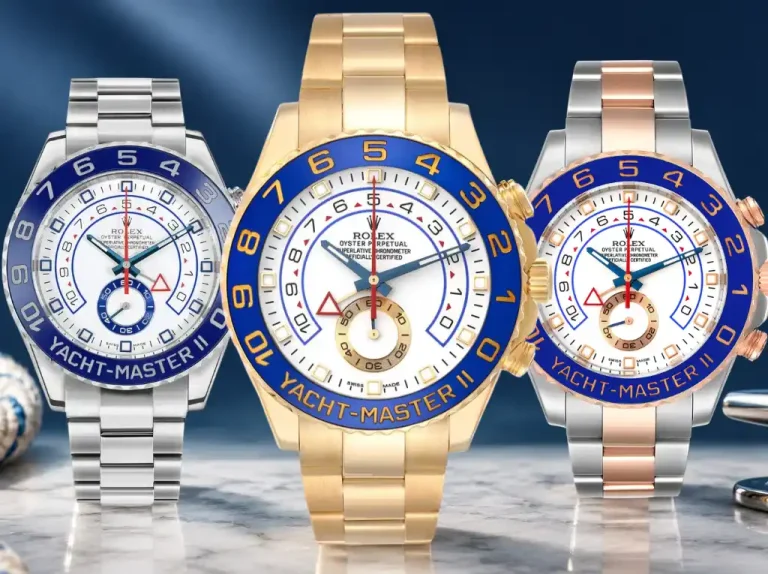
Unlike the original Rolex Yacht-Master, which combines nautical styling with everyday versatility, the Yacht-Master II was designed specifically for competitive sailing.
Unveiled in 2007, this specialized regatta chronograph was created to help sailors time the crucial start of a race. Its programmable countdown, mechanical memory and distinctive Ring Command bezel set it apart, while precious-metal, Everose Rolesor and Oystersteel versions shaped its evolution.
After the first-generation collection was discontinued in 2024, the Yacht-Master II returned in 2026 with a new generation and updated movement. Explore the Rolex Yacht-Master II’s history, from its sailing origins and key milestones to the technical changes that have shaped the collection.
Despite sharing a name, the Rolex Yacht-Master and Yacht-Master II are quite different timepieces. The differences go beyond case size and appearance, reflecting two distinct approaches to Rolex’s nautical watchmaking.
Introduced in 1992, the original Rolex Yacht-Master was designed as a refined maritime-inspired sports watch. It combines a robust construction with a versatile aesthetic suited to everyday wear. The Yacht-Master II, introduced in 2007, took a more specialized direction. Rather than focusing on general nautical appeal, it was developed as a mechanical instrument for competitive sailors.
A regatta is a competitive sailing event in which timing and positioning are crucial. Before a race begins, competing boats maneuver around the starting area, aiming to cross the starting line at precisely the right moment. The Yacht-Master II addresses this challenge with a programmable countdown that can be set from 1 to 10 minutes. Its mechanical memory retains the selected duration, while the original Ring Command bezel allows the wearer to interact with the movement and adjust the regatta timer.
Rolex developed the Yacht-Master II as a dedicated timing instrument for competitive sailors, rather than adapting an existing chronograph. Its programmable countdown and mechanical memory were designed around the demands of a regatta start.
Rolex’s longstanding involvement in competitive sailing helped shape this specialized approach to watchmaking. Through its associations with prestigious events such as the Rolex Sydney Hobart Yacht Race and Rolex Fastnet Race, the company developed a closer understanding of sailors’ timing requirements.
Combined with the Ring Command bezel, this complication gave the Yacht-Master II a distinct purpose within the brand’s Professional collection.
Rolex unveiled the Yacht-Master II in 2007, introducing a specialized regatta chronograph unlike anything else in its Professional collection. The original launch featured two precious-metal configurations: the Ref. 116688 in 18k yellow gold and the Ref. 116689 in 18k white gold with a platinum bezel. Both featured a substantial 44mm case, a large countdown display and an innovative mechanical complication designed specifically for competitive sailing.
The watch represented a significant departure from Rolex’s traditional sports-watch designs. Instead of relying on a conventional chronograph, it introduced a programmable countdown that allowed sailors to coordinate the critical starting sequence of a race.
The first-generation Yacht-Master II was powered by Calibre 4160, a dedicated chronograph movement featuring a column wheel and vertical clutch. Rolex later replaced it with Calibre 4161 when the Oystersteel Ref. 116680 arrived in 2013. Its defining feature was the Ring Command bezel, which interacted with the movement to access and lock the programmable countdown. A mechanical memory retained the selected countdown duration, allowing sailors to launch subsequent countdowns without reprogramming the watch.
This combination of mechanical engineering and practical functionality distinguished the Yacht-Master II from conventional chronographs, establishing its identity as a purpose-built sailing instrument.
Rolex gradually broadened the Yacht-Master II lineup beyond its original precious-metal configurations. The Ref. 116681, introduced in 2011, combined Oystersteel with 18k Everose gold in a two-tone Rolesor design. It offered a different aesthetic while retaining the collection’s distinctive regatta timing function.
In 2013, the collection expanded further with the Oystersteel Ref. 116680. This introduced a stainless-steel alternative to the more expensive precious-metal models, making the specialized chronograph available in a more understated configuration. These developments established the Yacht-Master II as a collection with several material options, rather than a single statement-making luxury watch.
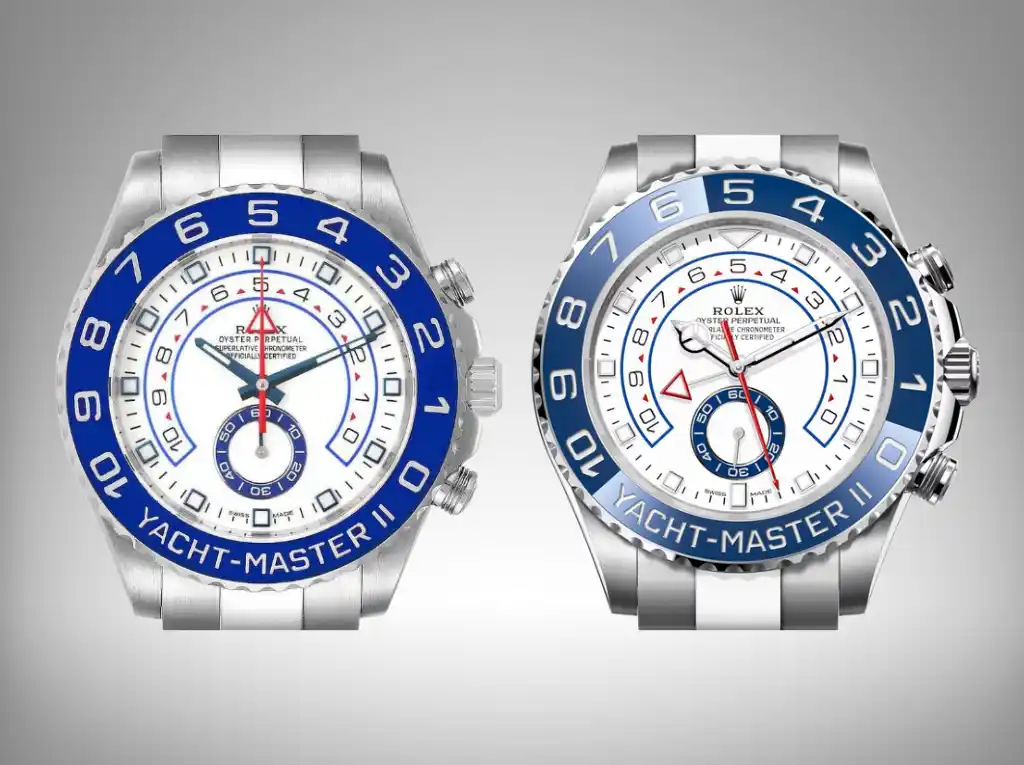
A decade after its debut, the Rolex Yacht-Master II received its first notable visual update in 2017. Rather than changing the watch’s overall design, Rolex focused on refining the dial to improve legibility and bring it closer to the familiar look of its Professional collection.
The most apparent change was the introduction of a Mercedes-style hour hand, replacing the slimmer baton-style design found on earlier models. The minute hand was also redesigned with a skeletonized construction, so it no longer blocks the regatta countdown display.
Rolex made further adjustments to the dial, replacing the square markers at 12 and 6 o’clock with an inverted triangle and a rectangular index, respectively. These subtle changes gave the watch a more balanced appearance without taking away from its distinctive character.
Importantly, the facelift did not extend to the movement or its defining complication. The Yacht-Master II continued to run on Calibre 4161, with its programmable countdown and Ring Command bezel unchanged. Rolex also retained the existing reference numbers, making this a design evolution rather than a new generation of the collection.
After 17 years, the Rolex Yacht-Master II reached an unexpected turning point in 2024 when Rolex discontinued the first generation. By then, the 18k white gold Ref. 116689 with its platinum bezel had already been discontinued in 2022. The remaining three configurations, the Oystersteel Ref. 116680, Everose Rolesor Ref. 116681 and yellow gold Ref. 116688, followed two years later, bringing the first generation to an end.
Rolex never publicly explained why it decided to discontinue the collection, leaving room for speculation among enthusiasts. Its specialized sailing complication, unconventional Ring Command bezel and imposing 44mm case may have contributed to its more niche appeal compared with other Rolex sports watches. However, these are possible factors rather than confirmed reasons behind the decision.
For a watch with such a distinctive identity, its departure left an interesting gap in Rolex’s lineup. The Yacht-Master II eventually returned in 2026 with a redesigned case, updated movement and a new approach to its signature countdown function.
The 2026 relaunch introduced two new references: the Oystersteel Ref. 126680 and the 18k yellow gold Ref. 126688. Both retain the collection’s familiar 44mm case size and are waterproof to 100 meters (330 feet), but Rolex redesigned the dial, countdown display and operating mechanism to make the watch easier to use during competitive sailing.
At the heart of the second-generation Yacht-Master II is Calibre 4162, an evolution of the previous Calibre 4161. This self-winding chronograph movement incorporates a column wheel and vertical clutch, alongside Rolex’s Chronergy escapement. The movement offers an approximately 72-hour power reserve. Visually, the movement features a cut-out oscillating weight and bridges decorated with Rolex Côtes de Genève, reflecting the company’s attention to both mechanical performance and finishing.
However, the biggest change concerns how the wearer operates the regatta timer. Rolex removed the original Ring Command programming system and introduced a simpler pusher-based interface. The lower pusher sets the countdown duration in one-minute increments, while the upper pusher starts or stops the function.
Another notable first for Rolex is the counterclockwise movement of the countdown minute and seconds hands. This makes the remaining time easier to interpret as the hands approach zero, particularly during the final moments before a race begins. The countdown scale now sits on a dedicated graduated flange around the dial.
Despite these substantial changes, Rolex retained several defining characteristics of the original Yacht-Master II. Both generations feature a 44mm case and a programmable regatta countdown with mechanical memory.
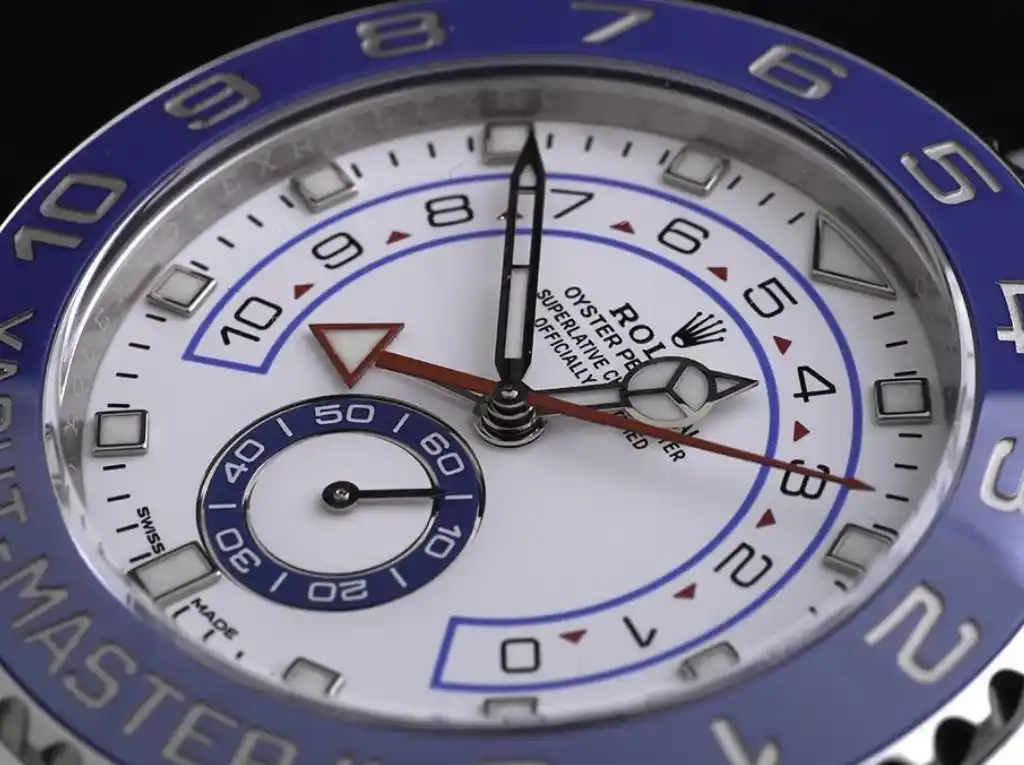
The new models also retain a blue Cerachrom bezel, although its function has changed: it is now a bidirectional 60-minute timing bezel, and during the final 30 seconds of a countdown the first half of its scale can be read as seconds.
| Feature | First generation | Second generation (2026) |
|---|---|---|
| References | 116688, 116689, 116681, 116680 | 126680, 126688 |
| Materials | Yellow gold, white gold, Everose Rolesor, Oystersteel | Oystersteel, yellow gold |
| Movement | Calibre 4160 / 4161 | Calibre 4162 |
| Bezel | Ring Command with Cerachrom insert | Bidirectional bezel with blue Cerachrom insert |
| Countdown programming | Ring Command bezel and crown | Lower pusher |
| Countdown display | Clockwise | Counterclockwise |
| Power reserve | Approximately 72 hours | Approximately 72 hours |
The 2026 relaunch represents more than a return to the Rolex lineup. By rethinking the countdown interface while preserving its original sailing purpose, Rolex has given the Yacht-Master II a new direction without losing what made it distinctive.
From its introduction as a precious-metal regatta chronograph to its return with a redesigned movement, the Yacht-Master II has undergone several important changes. The following timeline highlights the milestones that shaped the collection.
| Year | Milestone | Significance |
|---|---|---|
| 1992 | Original Yacht-Master introduced | Established Rolex’s luxury nautical watch collection. |
| 2007 | Yacht-Master II unveiled | Introduced a programmable regatta countdown with mechanical memory. |
| 2011 | Everose Rolesor Ref. 116681 introduced | Added a two-tone Oystersteel and Everose gold configuration. |
| 2013 | Oystersteel Ref. 116680 introduced | Added an Oystersteel model and introduced Calibre 4161. |
| 2017 | Design refinement | Introduced Mercedes-style hands and revised hour markers. |
| 2022 | Ref. 116689 discontinued | The white gold and platinum configuration left the collection. |
| 2024 | First generation discontinued | The remaining Yacht-Master II references were withdrawn from Rolex’s catalog. |
| 2026 | Second generation introduced | Refs. 126680 and 126688 debuted with the new Calibre 4162. |
The Yacht-Master II is a regatta chronograph built to time the start of a sailing race. Its programmable countdown can be set from 1 to 10 minutes and retains the selected duration through a mechanical memory. During the countdown, the timer can be synchronized with the official start signal, helping sailors time their approach to the starting line.
In Singapore, Rolex lists the Oystersteel Yacht-Master II Ref. 126680 at S$28,600. The 18k yellow gold Ref. 126688 is priced considerably higher, at S$85,500 on Rolex Singapore’s model page. Rolex’s official prices may change, so check Rolex’s official website or an authorized retailer for the latest pricing.
The Yacht-Master II holds its value reasonably well, although it does not command the same premiums as models like the Daytona or GMT-Master II. First-generation pieces usually sell for less than their last retail price, which makes them a more affordable way to own the original Ring Command model. The new 2026 version is a different story. As of November 2026, the steel Ref. 126680 retails at S$28,600 in Singapore, while pre-owned asking prices are around S$30,500. Condition and completeness still make a big difference, so compare similar watches before you buy or sell.
No. Rolex discontinued the first-generation Yacht-Master II in 2024 but reintroduced the collection in 2026 with two new references: the Oystersteel Ref. 126680 and the 18k yellow gold Ref. 126688.
The Rolex Yacht-Master II has carved out a distinctive place in the brand’s history through its specialized sailing complication and unconventional engineering. From its 2007 debut to its 2026 return, the collection has continued to evolve while staying true to its original purpose. Its latest generation shows how Rolex can preserve a watch’s identity while rethinking the technology behind it.
Key Takeaways:
The Rolex Yacht-Master II has changed considerably since 2007, from its original Ring Command bezel to the redesigned countdown system introduced in 2026. For earlier models, the condition of the countdown mechanism is worth checking before making a purchase. Explore Watchbook’s authenticated Rolex Yacht-Master II collection to compare available references, with every watch checked against our 60-point inspection.


