

Scan the QR Code on Your Phone To Download the App



Scan the QR Code on Your Phone To Download the App
Scan the QR Code on Your Phone To Download the App


A few tiny dots or dashes can reveal more about a Rolex than you might expect. Found beneath the coronet on the winding crown, the Rolex crown markings offer clues to the watch’s sealing system and, in some cases, its material.
That distinction matters because Rolex uses two main crown systems, Twinlock and Triplock, with different sealing designs and marking patterns. Yet markings can vary across production eras, and a replacement crown may not match the watch’s original configuration.
Whether you own a Rolex or are considering a vintage or pre-owned model, knowing what to look for can help you assess its details with confidence. In this guide, we explain what each symbol means, how to identify crown materials, how Twinlock compares with Triplock, and how crown markings fit into a wider authenticity check.
The winding crown is the small component attached to the side of a Rolex case. It allows you to manually wind the movement, set the time and, on applicable models, adjust the date.
On its outer face, you will find the Rolex coronet, the brand’s distinctive five-point crown logo. Look closely beneath it, and you may notice small dots or a horizontal dash. These are not decorative details. Rolex describes them as a way to recognize the crown’s sealing system: one or two markings for Twinlock and three for Triplock. Collectors also read them as a clue to the crown’s material. The coronet also appears elsewhere on the watch, including the dial, clasp and crystal.
Rolex uses different winding crown systems to suit each watch’s intended function. The two main systems, Twinlock and Triplock, provide different levels of protection against water ingress through their respective sealing designs. The small dots and dashes beneath a Rolex crown can indicate its water-resistance system and material.
Both systems use rubber gaskets to create sealed areas between the winding crown and the watch case, helping prevent water from entering the movement.
Crown markings are not universal authentication codes. Their interpretation can vary by production period, and replacement service crowns may carry different markings from the originals.
The markings differ depending on whether the watch uses a Twinlock or Triplock crown. Each system has its own combination of dots and dashes, making it easier to identify the crown’s material when you know what to look for.
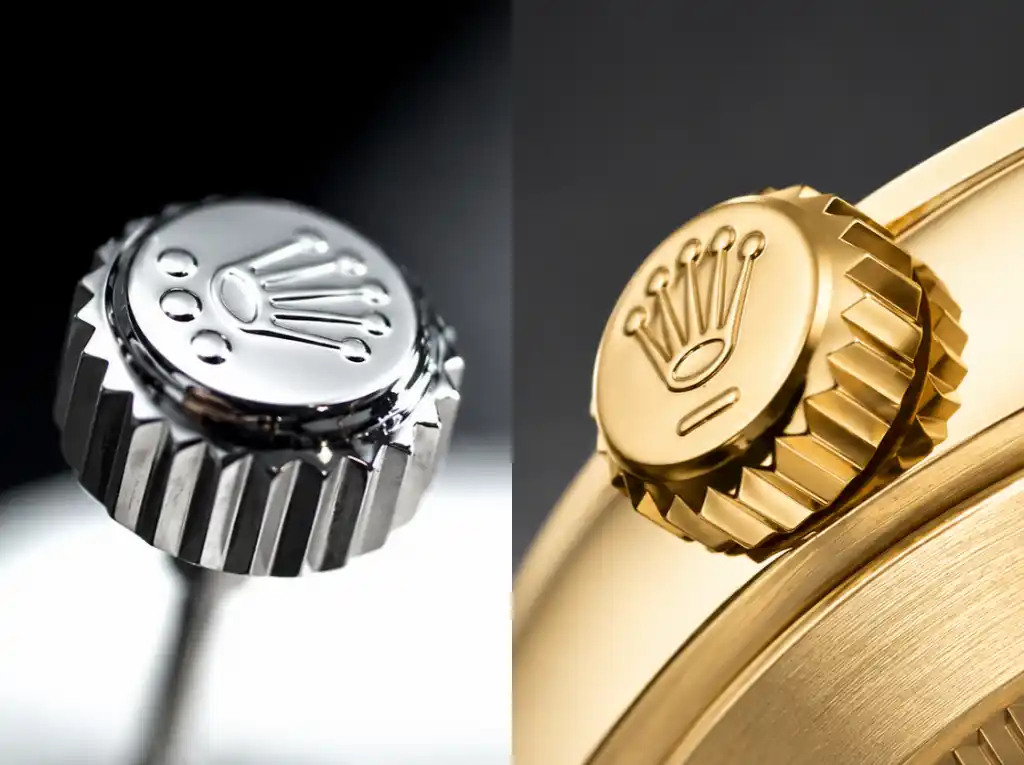
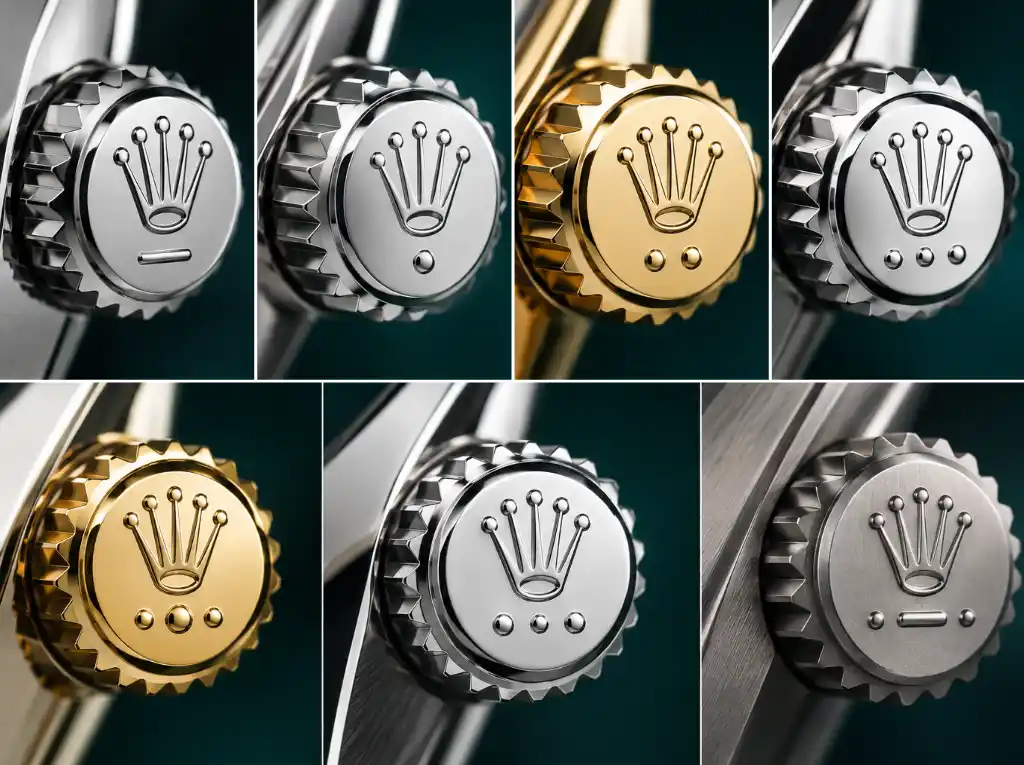
Rolex Twinlock crowns feature different combinations of dots and dashes depending on their material and production period. The markings provide an indication of the crown’s material, although older models may follow different conventions.
| Marking | Material indicated |
|---|---|
| Single horizontal dash | Stainless steel and some two-tone models |
| One dot | Platinum |
| Two dots | Yellow gold, white gold or Everose gold |
Introduced by Rolex in 1953, the Twinlock crown system uses two sealing zones to protect the movement from moisture and water ingress. One is located inside the winding crown, while the other sits within the crown tube. Together, these two sealing points help maintain water resistance of up to 100 meters on models such as the Datejust, Day-Date and Oyster Perpetual.
Triplock crowns generally feature three dots beneath the Rolex coronet. The arrangement and relative sizes of the dots can indicate the crown material, while certain RLX titanium models use a distinct dot-dash-dot marking.
| Marking | Material indicated |
|---|---|
| Three equal-sized dots | Stainless steel or two-tone |
| Larger center dot | Yellow gold, white gold or Everose gold |
| Larger outer dots | Platinum |
| Two dots separated by a horizontal dash | RLX titanium |
The dot-dash-dot marking can be found on certain RLX titanium models, including the Yacht-Master 42 and Deepsea Challenge.
These markings can indicate the winding crown’s material, not necessarily the material of the entire case or bracelet. Marking conventions have also changed over time, so vintage Rolex crowns may display patterns that differ from those found on modern models.
First fitted to the Sea-Dweller in 1970, the Triplock crown system adds a third sealing zone for greater protection against water ingress. Together, its sealing points help prevent water from entering the watch case through the winding crown, making it suitable for professional dive watches designed to withstand greater water pressure.
You will commonly find Triplock crowns on the Submariner, Sea-Dweller and Deepsea collections.
| Feature | Twinlock | Triplock |
|---|---|---|
| Introduction | 1953 | 1970 |
| Sealing zones | Two | Three |
| Typical water resistance | Up to 100m | Varies by model, up to 11,000m on the Deepsea Challenge |
| Common applications | Datejust, Day-Date, Oyster Perpetual | Submariner, Sea-Dweller, Deepsea, GMT-Master II |
| Crown markings | Dash or one to two dots | Three dots or dot-dash-dot for RLX titanium |
These examples are not fixed rules for every reference or production year. Always check the original specifications when identifying the crown fitted to a specific Rolex model.
Crown marking conventions have changed over time. For example, older Twinlock crowns used two dots to indicate white gold, whereas modern crowns use two dots for yellow, white and Everose gold. When examining a vintage Rolex, consider its reference number and approximate production year alongside the crown markings.
Vintage Rolex watches may retain their original winding crowns or have replacement components fitted during servicing. These replacement crowns can carry markings that differ from the original configuration. Crown size and design may also vary depending on the manufacturing period.
When identifying a vintage Rolex crown, consider the watch’s reference number, approximate production year and service history rather than relying on the markings alone.
Whether you’re checking your own Rolex or assessing a pre-owned one, follow these steps to examine the markings more closely:
Wear, polishing and dirt can make small markings difficult to distinguish. Use a magnifying loupe and good lighting for a closer inspection. Avoid aggressive cleaning or polishing, as this may damage the markings. If the pattern remains unclear, consult a qualified watchmaker for professional assessment.
Although genuine Rolex crowns have recognizable marking patterns, these symbols alone cannot prove that a watch is authentic. Counterfeit watches can reproduce the Rolex coronet and its associated dots or dashes, making visual identification unreliable. Rolex introduced a laser-etched coronet at the 6 o’clock position on the crystal as an anti-counterfeiting feature.
A genuine Rolex may also have a replacement service crown with markings that differ from its original configuration. This is particularly relevant when examining vintage and pre-owned models, where components may have been replaced during servicing.
When evaluating a pre-owned Rolex, look beyond the winding crown and examine the watch as a whole. Pay attention to these details:
Twinlock uses two sealed zones, while Triplock has three. The additional sealing zone provides greater protection against water ingress, making Triplock suitable for professional diving watches and other Rolex Professional models. Twinlock is typically found on models such as the Datejust, Day-Date and Oyster Perpetual.
Three dots beneath the Rolex coronet generally indicate a Triplock winding crown. On modern models, three equal-sized dots indicate stainless steel or two-tone, a larger center dot indicates gold, and larger outer dots indicate platinum. Marking conventions may differ on older crowns.
Two dots typically appear on Twinlock crowns. On modern Rolex models, they generally indicate a gold crown, whether yellow, white or Everose gold. On some older watches, the marking was used for white gold.
No. Although genuine Rolex crowns have recognizable marking patterns, these symbols alone cannot prove that a watch is authentic. Counterfeit watches can reproduce the coronet and its associated markings. A proper assessment should also consider the case, dial, movement, bracelet and service history.
Yes. A winding crown may be replaced during servicing if it becomes worn, damaged or no longer seals effectively. The replacement may carry different markings from the original, particularly on older watches, so a mismatch does not automatically mean the watch is counterfeit. However, the new crown should be compatible with the model and reference, and the watch should pass a water-resistance test afterwards to confirm its seals are working.
Rolex crown markings provide useful clues about a winding crown’s sealing system and material. However, their meaning depends on the model and production period, so they should always be assessed alongside the watch’s reference and service history.
Key Takeaways:
Rolex crown markings can help identify whether a watch uses a Twinlock or Triplock crown and indicate the crown’s material, but they aren’t enough to determine a watch’s authenticity on their own. For a closer look at a Rolex’s details and whether they match its reference, speak with our team at Watchbook. Explore our curated selection of authenticated Rolex watches.


