

Scan the QR Code on Your Phone To Download the App



Scan the QR Code on Your Phone To Download the App
Scan the QR Code on Your Phone To Download the App


When it comes to discussions about high-end timepieces, Omega and Rolex are consistently at the forefront. Due to their longevity and reputation for quality craftsmanship, these brands have become synonymous with high-end timepieces.
While Omega and Rolex share some similarities in design and manufacturing, each brand brings unique attributes. In order to make an informed decision between these two luxury watch brands, it is essential to consider various factors such as design, engineering, and overall appeal.
In this guide, we’ll tackle all that so you can ultimately determine which watch brand best suits you.
Omega has a longer history than Rolex. Omega was founded in 1848, focusing on accurate pocket watches. Rolex, established in 1905, aimed for reliable and elegant wristwatches, becoming renowned for luxury models like the Submariner and Daytona. Let’s delve into the intriguing histories of these two renowned watch brands
Omega was founded by Louis Brandt in 1848 and officially renamed OMEGA in 1894. The company’s headquarters are in Bienne, Switzerland, now owned by the Swatch Group.
Initially, its history shows that the brand focused on producing precise and accurate pocket watches. Later, Omega distinguished itself by providing timekeeping for numerous prestigious events, such as the Olympic Games.
It has also maintained a long association with space exploration, with the Omega Speedmaster being the first watch on the moon.
On the other hand, Rolex was established several years later, in 1905, in London, England. The company’s founder, Hans Wilsdorf, envisioned developing a reliable wristwatch that was both elegant and precise.
In 1910, Rolex obtained the first chronometer certification for a wristwatch, showcasing its commitment to precision and accuracy. The company later moved its headquarters to Geneva, Switzerland, a privately-owned business.
Rolex is renowned for its iconic models like the Submariner, Daytona, and Oyster Perpetual, which have become symbols of luxury and prestige.

Omega watches have clean, balanced designs, often featuring traditional elements such as Roman or stick indices, simple bezel designs, and elegant, understated faces. Even their sports watches, like the iconic Speedmaster, retain a sense of refinement and elegance.
Embracing the new, the brand continually innovates with materials, movements, and designs. This forward-thinking approach is evident in watches like the Seamaster Planet Ocean, with its bold use of color and cutting-edge co-axial movement.
Omega maintains a strong commitment to functionality, visible in their tool watches. Its professional and sports watches, such as the Seamaster Diver 300M, and its pilot watches, like the Speedmaster, are popular examples of its functional design philosophy.
One of the most iconic movements in Omega’s history is the manual-wind caliber 321. This movement, used in the Omega Speedmaster, was the one that powered the first watch worn on the moon during the Apollo missions.
In recent years, Omega has developed the Master Co-Axial caliber, notable for its resistance to magnetic fields. Moreover, Omega’s Co-Axial escapement, introduced in 1999, is a revolutionary innovation in horology.
Furthermore, Omega has consistently incorporated silicon balance springs in their movements for their anti-magnetic properties and for providing more precise timekeeping. Most of Omega’s movements today are certified by the METAS, also known as the Swiss Federal Institute of Metrology.
Omega uses a range of high-quality materials for its watches. These include stainless steel and titanium for durability, precious metals like gold and their proprietary Sedna Gold for luxury models, and ceramic for scratch resistance and aesthetic appeal.
The watch crystals are usually synthetic sapphire for clear visibility and resistance to scratching. Straps come in stainless steel, leather, and rubber, depending on the specific model and purpose.
Omega is known for its innovative approach to the watch industry, including developing the co-axial escapement for improved mechanical efficiency and the Master Co-Axial Calibers for superior magnetic resistance.
Also, Omega introduced the first industrially produced wristwatch tourbillon and has a rich legacy of precision records and involvement in space exploration.
The brand has also pioneered anti-magnetic watches by introducing the Aqua Terra >15,000 Gauss, which can withstand magnetic fields of over 15,000 Gauss.
Omega watch prices vary widely depending on the model, materials, and features. Some entry-level models start around $2,500-$3,000. In contrast, higher-end models, particularly those in precious metals or complex complications, can cost upwards of $30,000.
Meanwhile, limited edition or vintage Omega watches may command even higher prices. Some are sold in secondary markets for between S$60,000 and over S$100,000.
Yes, Omega is indeed considered a high-end watch brand. The company is renowned for its exceptional craftsmanship, innovative technology, precision, and durable designs. Omega watches are often seen on the wrists of celebrities, professionals, and watch enthusiasts worldwide.
The brand’s reputation has been solidified by its historical achievements, including being the first-ever watch on the moon as well as the official timekeeper of the prestigious Olympic Games. However, while Omega is a luxury brand, it is often positioned as a more accessible luxury than brands like Rolex or Patek Philippe.
While Omega watches are known for their quality and hold their value relatively well, they generally do not retain or appreciate value to the same extent as Rolex watches.
Omega produces more watches per year than Rolex, and they are more readily available. This availability can make them less likely to appreciate in value.
However, certain Omega models, especially rare or limited-edition pieces, can hold their value quite well and may even appreciate. This includes watches like the Omega Speedmaster Professional “Moonwatch,” which has a strong following among watch enthusiasts due to its historical significance.

Rolex watches are known for using high-quality materials, robust cases, iconic features like the fluted bezel on many of their models, and the Cyclops lens over the date window.
Further, Rolex has various collections, each with its own aesthetic, though all share the Rolex identity. The Submariner and Sea-Dweller are known for their rugged, sporty design, suitable for deep-sea exploration. Meanwhile, the Daytona has a more technical, racing-inspired aesthetic.
On the more formal side, collections like the Datejust and Day-Date exhibit classic elegance with their balanced dial designs, often featuring Roman or baton indices, and available with various sophisticated dial colors and materials.
Rolex has developed the Caliber 3135, one of their most well-known and widely-used movements, powering various models like the Submariner Date and the Datejust. It’s lauded for its high performance, precision, and magnetic resistance.
The brand also uses the Caliber 4130 for the Daytona models, a highly respected chronograph movement. It includes fewer components, enhancing its reliability. Furthermore, it incorporates a Parachrom hairspring, providing greater resistance to shocks and temperature variations.
More recently, Rolex has introduced new movements such as the Caliber 3235, which boasts improved power reserve, precision, and resistance to shocks and magnetism. All Rolex movements have obtained the Superlative Chronometer certification, passing the Official Swiss Chronometer Testing Institute (COSC) standards.
Rolex uses high-quality materials to craft its watches. They often use a specific type of stainless steel known as 904L, which is more corrosion-resistant and has a unique sheen. Rolex also uses 18K gold in yellow, white, and their proprietary Everose (rose gold) versions.
For their most luxurious models, they use 950 platinum. Rolex employs scratch-resistant sapphire crystal for the watch faces. Some models also incorporate precious stones like diamonds and ceramics for bezel inserts, particularly in their professional watch line.
Rolex is renowned for its trailblazing innovations in watchmaking. The brand invented the first waterproof watch, the “Oyster,” in 1926. They also introduced the first self-winding mechanism with a perpetual rotor in 1931.
Other notable innovations include the creation of the GMT-Master, which allows for tracking of dual time zones, and the Submariner, the first divers’ watch waterproof to a depth of 100 meters. The Rolex Deepsea is just as impressive.
Rolex’s advancements extend to the development of new materials, such as the corrosion-resistant 904L steel and Everose gold, their exclusive version of 18K rose gold.
The popular Rolex watches have prices that vary greatly based on the model, materials, and complications. Most entry-level models like the Rolex Oyster Perpetual can start around $5,000 – $6,000, while iconic models like the Submariner and Daytona may cost upwards of $10,000 – $15,000.
On the other hand, high-end Rolex models made from precious metals or featuring diamonds have higher values. Meanwhile, limited or highly sought-after models can command even higher prices in the secondary market, with some costing over a million Singaporean Dollars.
Several factors affect the price difference between Rolex and Omega watches. Rolex’s prestigious reputation, attention to detail, and use of high-quality materials are reasons their watches command higher prices.
Moreover, Rolex’s movements are chronometer certified and have a proven precision and reliability track record. The brand’s commitment to constant innovation and improvement also helps maintain the exclusivity and value of the Rolex name.
The following sections showcase a curated selection of stellar watches from Rolex and Omega. We’ve selected models from each category and compared them against their counterparts from the other brand.
This comparative approach aims to accentuate the unique attributes that Rolex and Omega bring to the table for luxury watch enthusiasts. Through this lens, the distinctions between these two eminent watchmakers become even more fascinating.

Rolex Datejust Turn-O-Graph 116261 vs. Omega Globemaster 130.33.39.21.03.001
|
Rolex Datejust Turn-O-Graph 116261 |
Omega Globemaster 130.33.39.21.03.001 |
|
|---|---|---|
|
Aesthetics |
|
|
|
Movement |
|
|
|
Materials |
|
|
|
Innovation |
|
|
|
Average Price in the Secondary Market |
S$12,949 |
S$5,800 |

Rolex Submariner Date 126610LN vs. Omega Seamaster 215.92.46.21.01.001
|
Rolex Submariner Date 126610LN |
Omega Seamaster 215.92.46.21.01.001 |
|
|---|---|---|
|
Aesthetics |
|
|
|
Movement |
|
|
|
Materials |
|
|
|
Innovation |
|
|
|
Price in the Secondary Market |
S$18,589 |
S$18,536 |

Rolex GMT-Master Pepsi 126719BLRO vs. Omega Seamaster 215.92.46.22.03.001
|
Rolex GMT-Master Pepsi 126719BLRO |
Omega Seamaster 215.92.46.22.03.001 |
|
|---|---|---|
|
Aesthetics |
|
|
|
Movement |
|
|
|
Materials |
|
|
|
Innovation |
|
|
|
Price in the Secondary Market |
S$61,993 |
S$10,080 |

Rolex Air King 116900 vs. Omega British Airforce 2777
|
Rolex Air King 116900 |
Omega British Airforce 2777 |
|
|---|---|---|
|
Aesthetics |
|
|
|
Movement |
|
|
|
Materials |
|
|
|
Innovation |
|
|
|
Price in the Secondary Market |
S$10,484 |
S$8,727 |

Rolex Mil-Sub 5513 Submariner Military vs. Omega WW2 Military Ultra Rare 2179
|
Rolex Mil-Sub 5513 Submariner Military |
Omega WW2 Military Ultra Rare 2179 |
|
|---|---|---|
|
Aesthetics |
|
|
|
Movement |
|
|
|
Materials |
|
|
|
Innovation |
|
|
|
Price in the Secondary Market |
S$215,491 |
S$3,492 |

Rolex Daytona 116506 vs. Omega Speedmaster Racing 329.23.44.51.06.001
|
Rolex Daytona 116506 |
Omega Speedmaster Racing 329.23.44.51.06.001 |
|
|---|---|---|
|
Aesthetics |
|
|
|
Movement |
|
|
|
Materials |
|
|
|
Innovation |
|
|
|
Price in the Secondary Market |
S$151,122 |
S$10,342 |

Rolex Datejust Oysterquartz 17000 vs. Omega Seamaster Aqua Terra 220.10.28.60.54.001
|
Rolex Datejust Oysterquartz 17000 |
Omega Seamaster Aqua Terra 220.10.28.60.54.001 |
|
|---|---|---|
|
Aesthetics |
|
|
|
Movement |
|
|
|
Materials |
|
|
|
Innovation |
|
|
|
Price in the Secondary Market |
S$8,693 |
S$2,686 |
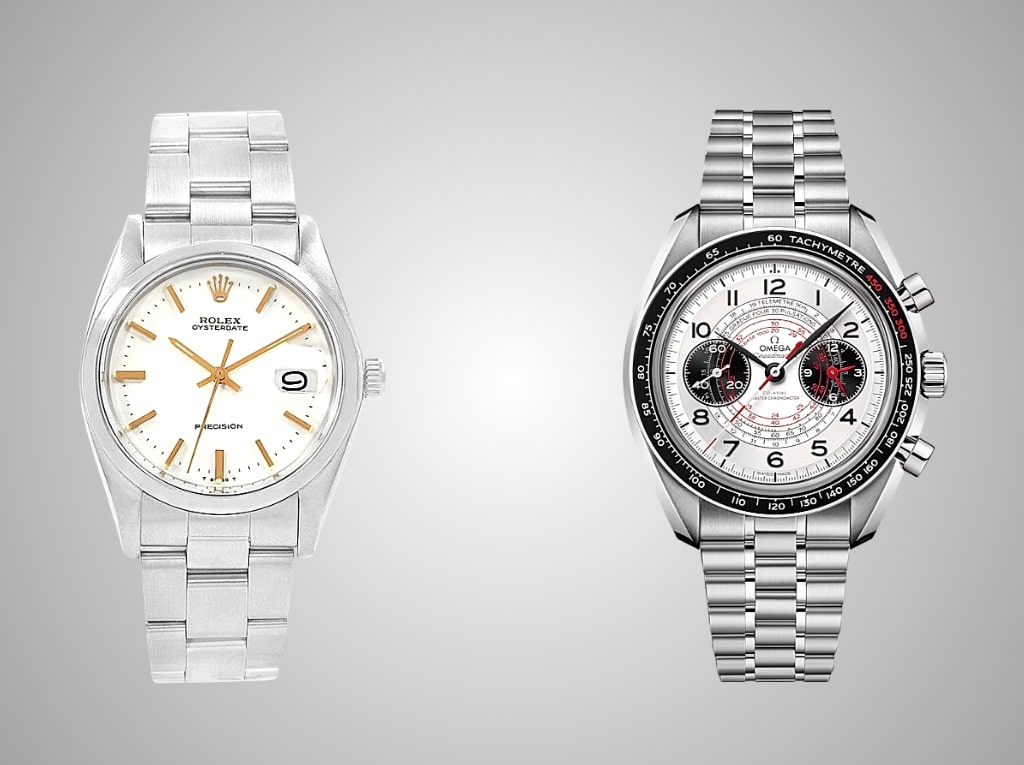
Rolex Oysterdate Precision Mechanical 6694 vs. Omega Speedmaster 329.30.43.51.02.002
|
Rolex Oysterdate Precision Mechanical 6694 |
Omega Speedmaster 329.30.43.51.02.002 |
|
|---|---|---|
|
Aesthetics |
|
|
|
Movement |
|
|
|
Materials |
|
|
|
Innovation |
|
|
|
Price in the Secondary Market |
S$5,035 |
S$8,753 |
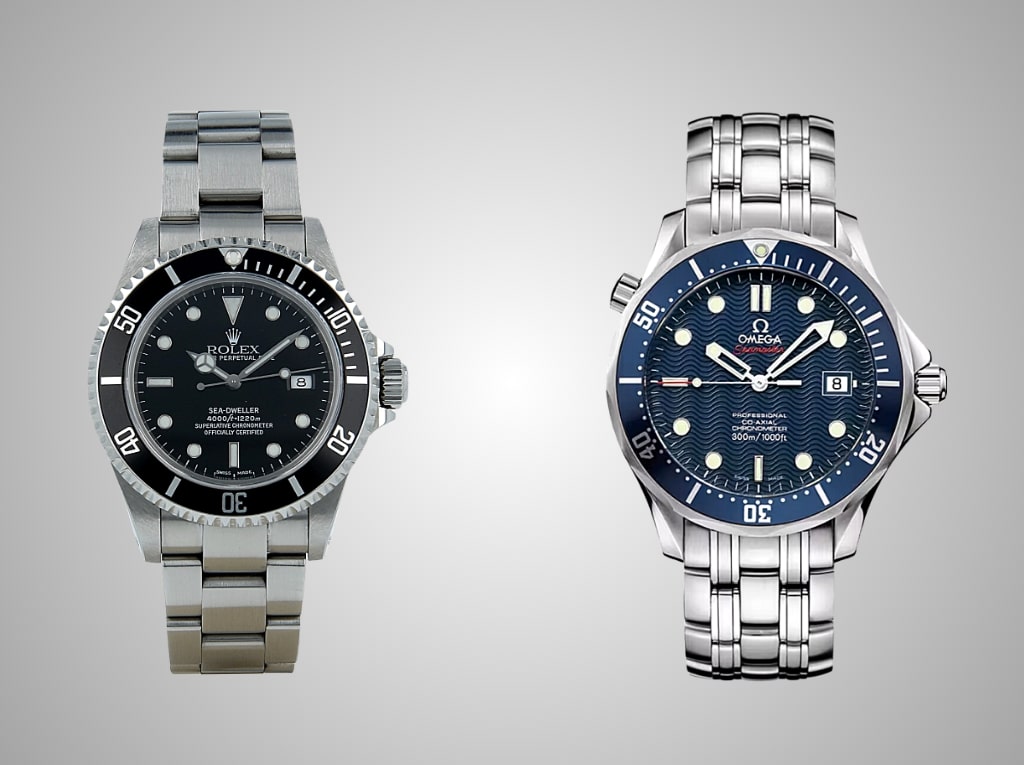
Rolex Sea-Dweller 4000 16600 vs. Omega Seamaster Diver 300 M 2220.80.00
|
Rolex Sea-Dweller 4000 16600 |
Omega Seamaster Diver 300 M 2220.80.00 |
|
|---|---|---|
|
Aesthetics |
|
|
|
Movement |
|
|
|
Materials |
|
|
|
Innovation |
|
|
|
Price in the Secondary Market |
S$13,171 |
S$4,006 |

Rolex Daytona Platinum Ice 116506 vs Omega Speedmaster Professional Moonwatch 3570.50.00
|
Rolex Daytona Platinum Ice 116506 |
Omega Speedmaster Professional Moonwatch 3570.50.00 |
|
|---|---|---|
|
Aesthetics |
|
|
|
Movement |
|
|
|
Materials |
|
|
|
Innovation |
|
|
|
Price in the Secondary Market |
S$151,122 |
S$5,657 |
When deciding between Rolex and Omega watches, it is crucial to consider more than just their aesthetics. Both Rolex and Omega offer exceptional craftsmanship and design, but factors such as movements, materials, and other important aspects should also be considered.
Consider your specific needs and preferences, ensuring that the chosen watch’s movement, materials, features, and overall functionality align with your requirements to make the best choice for your wrist.
One of the most evident differences between Omega and Rolex watches is their price points. For instance, the Omega Speedmaster is averagely priced at S$2,605, whereas the Rolex Daytona has a price range of S$26,622 to S$243,124.
Regarding availability, Rolex watches are more exclusive and harder to find. Limited production quantities and high demand lead to long waiting lists for popular Rolex models. Conversely, Omega watches are more widely available.
Another factor to consider is the resale value of these prestigious brands. Rolex watches hold better value in the pre-owned market due to their brand reputation and exclusivity. However, the best Omega watches may fetch a higher average resale value than the worst Rolex watches.
One must consider personal preferences and individual needs when comparing Omega and Rolex. While both brands offer exceptional timepieces, each excelling in different aspects, the choice ultimately comes down to one’s taste and budget.
Key Takeaways
Looking to buy or sell your luxury watches? Watchbook is your one-stop destination for trading Rolex, Patek Philippe, Tissot, Sinn, Zenith, and other luxury timepieces. Find your next watch today!


